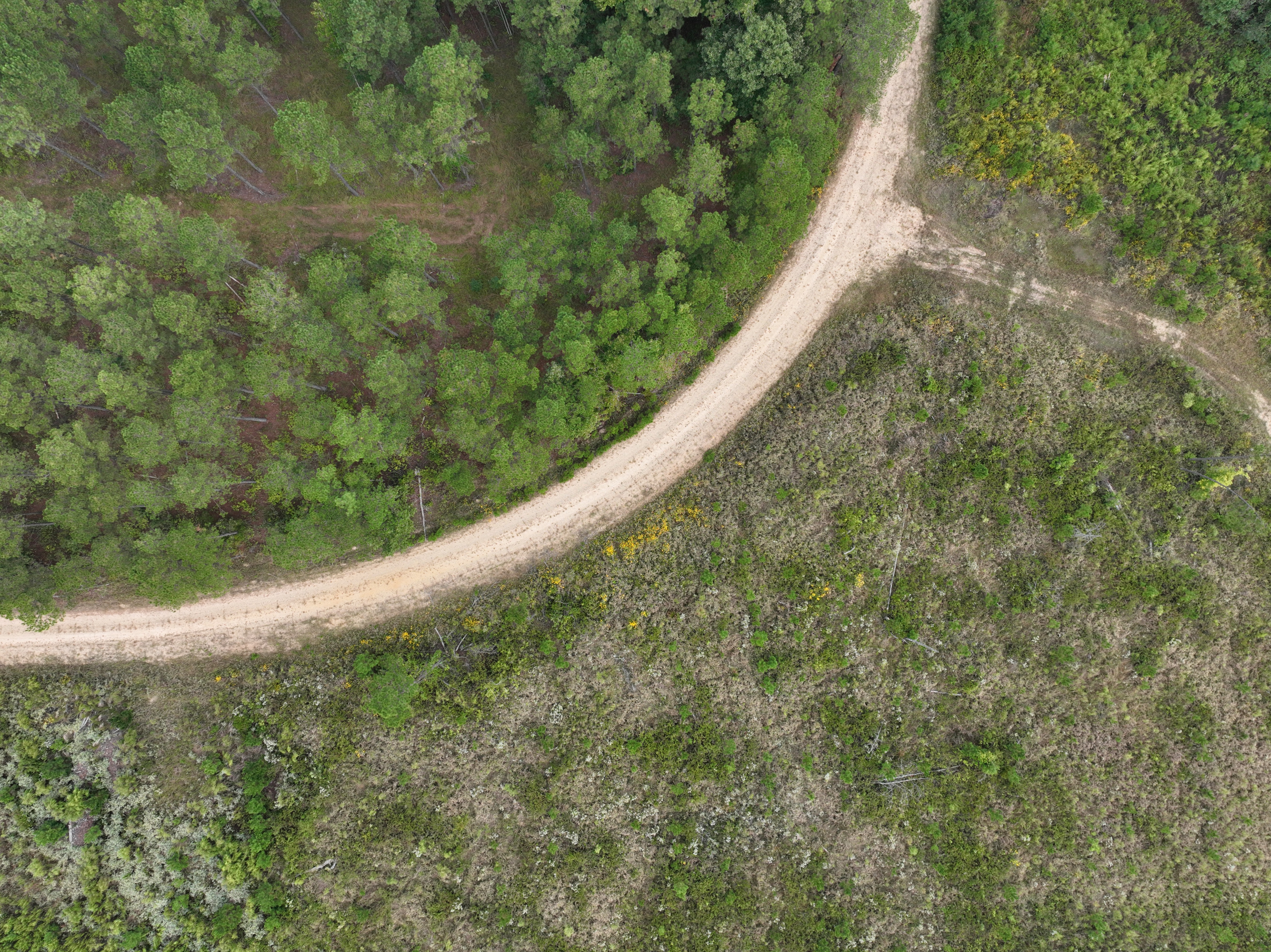
A 1,208-tree validation study across sparse and dense pine stands.
Tree height is the single most expensive measurement in forestry. Getting it right means LiDAR: a $60,000 sensor, a specialized drone, and a five-figure acquisition cost per flight.
We replaced the sensor with software. A standard camera drone and a Gaussian Splat reconstruction pipeline, measuring the same trees against best-in-class LiDAR. One at a time.
1,208 trees. 99% within one meter. 0.32 m RMSE. Near-zero bias.
Below is the full dataset: every stand, every tree, every number. Nothing is averaged away.
Loading 3D reconstruction
The Setup
Equipment. A DJI Matrice 4E flown at 90 m AGL, 80/80 overlap. The same camera drone and flight plan you'd use for any mapping job. From those images, we built a 3D Gaussian Splat of each stand.
Reference. A Resepi XT-32 drone LiDAR: $60,000, 8,500+ points/m², millimeter-range laser returns. This is the measurement you'd trust with a timber sale.
Comparison. Both datasets registered to the same coordinate system. Same crown segmentation polygons applied to both. Height = crown apex minus interpolated ground elevation, derived via cloth simulation filtering on each point cloud. The only variable between columns is the sensor.
The Head-to-Head
Sparse Canopy | 110 trees
Open canopy, well-separated crowns, unobstructed ground. This is the cleanest test case. Isolated trees where both sensors see the full crown.
MAE of 0.21 m, RMSE of 0.27 m. 95% of trees land within half a meter of LiDAR. That's tighter than most field crews manage with a clinometer and rangefinder.
Dense Canopy | 52 trees
Crowns overlap. Ground visibility drops. This is where passive photogrammetry has historically broken down, and the test that matters for operational inventory. 52 trees, tightly stocked.
RMSE holds at 0.16 m, MAE of 0.12 m. Accuracy stays within operational tolerances. Every tree in this stand falls within one meter of LiDAR.
Accuracy Summary
Splat vs LiDAR across all sites
| Site | MAE | RMSE | Bias | SD | < 0.5m | < 1m | < 2m |
|---|---|---|---|---|---|---|---|
| All1,208 | 0.24m | 0.32m | -0.12m | 0.30m | 90% | 99% | 100% |
| Sparse793 | 0.28m | 0.35m | -0.20m | 0.29m | 87% | 98% | 100% |
| Dense415 | 0.17m | 0.24m | +0.03m | 0.24m | 97% | 100% | 100% |
What This Means
An RMSE of 0.32 m matches what a trained crew gets with a clinometer and laser rangefinder. The difference: a crew measures 30–80 acres per day. A camera drone covers that in a single flight.
Near-zero bias means individual over- and under-estimates cancel at the stand level. Mean dominant height (the number that drives site index, growth projections, and harvest timing) tracks LiDAR closely. The aggregate is more reliable than any single-tree comparison suggests.
When per-flight cost drops by two orders of magnitude, the calculus changes. Instead of one LiDAR snapshot every three to five years, you fly quarterly. You catch thinning windows, storm damage, and growth stagnation before they cost you. Height becomes a time series, not a point estimate.
A handful of trees disagree by more than a meter, typically ambiguous crown boundaries in dense canopy. The explorer below lets you inspect every one.
What's Next
Height is the first measurement we're publishing. The same 3D reconstruction that produces these heights contains the geometry needed for diameter, taper, and crown structure — and we're working toward extracting all of it.
If you manage timberland or run a consulting forestry practice, we'd like to show you what this looks like on your stands.